Jeff Cooper spent most of his life training people to survive violence they didn't choose. A Marine officer who served in the Pacific during World War II and again during the Korean War, Cooper went on to found what's now known as Gunsite Academy in Paulden, Arizona in 1976, the training ground that shaped modern firearms and defensive instruction for decades of law enforcement and military students (Gunsite Academy). But the single idea of his that spread furthest beyond that training ground had nothing to do with a weapon. In his 1972 book Principles of Personal Defense, Cooper introduced what's now known as the Color Code, a simple framework for describing a person's state of mental readiness, not a description of danger itself, but a description of how prepared someone is to notice it (Athlon Outdoors).
A code built on awareness, not fear
Cooper's insight, and the reason the code has outlived its original military and law enforcement audience, is that it was never actually about weapons. It was about attention. He broke mental readiness into four conditions, White, Yellow, Orange, and Red, each one describing how tuned in a person is to their environment, not how afraid they should be of it (Jeff Cooper biography). Condition White is being relaxed and unaware, appropriate for sleep and almost nowhere else. Condition Yellow is relaxed but alert, aware of who and what is around you without expecting anything specific to happen. Condition Orange is noticing something particular that might be a problem and narrowing your attention onto it. Condition Red is that specific thing becoming an actual threat, the point at which you act on whatever plan you'd already started forming back in Orange.
Law enforcement trainers still teach this framework today, decades after Cooper first wrote it down, because it solves a problem that has nothing to do with firearms. Most people move through the world in Condition White, and most bad outcomes start there. Police1, a leading law enforcement training publication, put it plainly in a piece aimed at officers on and off duty, that the entire value of the code is in living in Condition Yellow as a baseline, not Orange or Red, since a mind that's relaxed but alert catches the small things before they become large ones (Police1). A companion piece from the same publication makes the point even more directly for anyone who thinks this only applies to people carrying a badge. Victims of violent crime consistently describe their attacker as having come out of nowhere, when what actually happened is that they were in Condition White the entire time, and the person who hurt them wasn't (Police1).
Why this matters to everyone, not just professionals trained for it
The instinct is to assume a framework built for Marines and police officers doesn't apply to an ordinary day. That instinct gets it backward. Cooper's own writing on the subject was aimed at civilians, not soldiers, precisely because the moments that call for Condition Yellow, walking to a car alone at night, meeting someone new in an unfamiliar place, noticing a conversation take a turn, happen to ordinary people far more often than they happen to trained professionals on duty. The code isn't a tool for people who expect violence. It's a tool for people who'd rather notice the small warning first, while there's still time to act on it calmly, than be forced to react to the large one after the moment to prevent it has already passed.
That distinction matters because Condition Yellow isn't anxiety, and it isn't paranoia. It's the opposite of both. A person cycling through worst-case scenarios in their head, jumping at every stranger, exhausted by their own vigilance, isn't in Condition Yellow, they're stuck somewhere closer to Orange without a reason to be there, and that's not sustainable for anyone. The actual skill the code teaches is staying relaxed while still being present, fully in the moment, aware of the room, the exits, the people in it, without treating every interaction as a threat. That's a habit, not a personality trait, and like any habit it gets easier with practice.
An attention economy built against Condition Yellow
Living in Condition Yellow used to compete mainly with daydreaming. Today it competes with an industry engineered specifically to win that competition. Infinite scroll, the design that removes any natural stopping point from a feed, was created in 2006 by UX designer Aza Raskin, who has since spoken publicly about regretting how effectively it captures attention it was never given permission to take (Center for Humane Technology). Tristan Harris, a former Google design ethicist who co-founded that same organization, has spent years documenting how social platforms use the same intermittent variable-reward mechanics found in slot machines, an unpredictable pull of likes, notifications, and new content, to keep attention locked on a screen rather than on the room a person is actually standing in (Center for Humane Technology). None of this is accidental. It's the business model.
Short-form video adds a second layer on top of the scroll itself. A peer-reviewed study published in Social Science Computer Review found a measurable link between heavy short-form video use and both reduced self-control and “phubbing,” the habit of ignoring the people and surroundings actually present in favor of a phone (Social Science Computer Review). Clinicians who study compulsive scrolling describe the same mechanism in plainer terms, that a feed with no bottom pulls attention away from the physical environment precisely because it was designed to, and getting that attention back takes a deliberate act, not a passive one (Psychology Today). A mind absorbed in a feed isn't in Condition White by accident. It's been placed there by design, and it stays there until something interrupts it, which is precisely the problem for anyone who needs to notice a warning sign before it becomes a threat.
The cost of that absorption shows up in real injury data, not just theory. Research examining U.S. emergency room visits found that more than 1,500 pedestrians were treated in a single year for injuries tied to phone use while walking, more than double the number just five years earlier, with researchers noting the true figure is likely higher given how few people report a phone as the cause (ScienceDaily). Local news coverage has documented the same absorption playing out in violent crime rather than traffic. A Los Angeles television station released footage of an attempted purse-snatching explicitly because the victim was looking at her phone in the moments before, and police framed the release as a reminder to stay aware of one's surroundings (FOX 5 DC). A separate Chicago case followed the same shape, where police investigating an assault in Lincoln Park specifically cited cell phone distraction as a factor in the victim's reduced awareness beforehand (CBS Chicago). These are individual, local reports rather than a nationwide study, and they should be read as exactly that, real, documented examples of the same pattern, not proof that every phone glance ends in harm. But the pattern they illustrate is the same one the injury data shows at scale, that Condition White has a cost, and a phone is one of the most effective tools ever built for keeping someone there.
A generation raised inside the feed
The erosion of attention isn't landing evenly across age groups, and the evidence is strongest for exactly the population now old enough to be booking their first sessions. The U.S. Surgeon General's 2023 advisory on social media and youth mental health found that up to 95 percent of teens aged 13 to 17 use a social media platform, more than a third report using it almost constantly, and the advisory states plainly that these platforms are engineered to maximize engagement and can measurably affect attention along with sleep (U.S. Surgeon General's Advisory). Social psychologist Jonathan Haidt's research, compiled most fully in The Anxious Generation, argues that the generational shift from unstructured, unsupervised play toward smartphone-mediated childhood tracks closely with a decline in sustained attention among the generation now old enough to be entering the workforce, a group that spans late Millennials through Gen Z and into Gen Alpha, the first generation to grow up with a tablet or smartphone available from early childhood (National Institutes of Health). Haidt's causal claims are contested by specialists in adolescent development, who argue the picture is more complicated than a single explanation (UC Irvine), and that disagreement is worth stating plainly rather than glossing over. What isn't contested is the underlying pattern the Surgeon General's advisory and the peer-reviewed short-form video research both independently document, that attention built around a feed behaves differently, and less resiliently, than attention that wasn't.
What that means in practice is that a habit of near-constant screen engagement, formed young and reinforced for years by design choices built to reward it, doesn't simply switch off the moment someone walks into a professional setting as an adult. It has to be noticed and deliberately corrected, the same way any other habit does. Condition Yellow isn't undone by having grown up with a phone in hand. It's just a habit that now has to be built on purpose, rather than assumed by default.
Why a model's profession makes awareness especially relevant
Modeling puts a person in exactly the situations the Color Code was built to address, and it does so more often than most professions do. A session frequently means meeting someone new, sometimes for the first time in person, in a private space, with no professional obligation on their part to have earned trust in advance. The Federal Trade Commission has documented a specific, recurring scam built around exactly this dynamic, individuals posing as photographers or talent scouts, promising modeling contracts, high pay, or “test shoots,” using that promise to extract compromising photos or money from targets who skew young and new to the industry (FTC Consumer Advice). Every one of those schemes depends on the same thing, a target who never got past Condition White long enough to notice the pattern before it was too late to walk away easily.
Sara Ziff, a professional model who has worked with brands including Stella McCartney and Tommy Hilfiger, founded the Model Alliance after seeing this dynamic firsthand in her own career, and has spent over a decade arguing publicly that the informal, unregulated structure of the industry, where a model often has no institutional backing standing between her and whoever she's meeting, is exactly what makes basic awareness a professional skill rather than an optional instinct (Fast Company). A documented 2024 case out of San Antonio shows exactly what the gap between Condition White and Condition Yellow can cost. A photographer told a client the session would take place at his home, then told the friend she'd brought along that the shoot would run long enough that she should leave, isolating the model before offering her a drink authorities later believed had been spiked (PetaPixel). Bobbie Jawish, a San Antonio photographer who specializes in women's empowerment work and runs Blue Willow Imagery, spoke publicly after the case broke, and her advice traces the Color Code almost exactly, bring someone with you, meet for coffee first before agreeing to anything, and trust the instinct that something feels off before a drink or a closed door removes your ability to act on it (KENS5).
Using the code, condition by condition
| Condition | What it means | What it looks like on a booking |
|---|---|---|
| White | Relaxed and unaware. Appropriate for sleep, and almost nowhere else. | Walking into a first meeting with a new photographer without having shared the address with anyone, or without having looked at anything beyond a few flattering photos. |
| Yellow | Relaxed but alert. Tuned into who and what is around you, with no specific threat identified. This is the baseline to live in. | Arriving with the venue and timeline shared with a trusted contact, having read the contract, and simply paying attention to the room and the person in it. |
| Orange | Something specific has caught your attention as a possible problem, and your focus narrows onto it. | A photographer pressures you to send a friend home, offers alcohol you didn't ask for, or brushes off a question about the shot list with “we'll figure it out.” |
| Red | The thing you noticed in Orange has become an actual threat. You act on the plan you already started forming. | Leaving the session, calling your trusted contact, or contacting law enforcement, calmly and immediately, without waiting to see if it resolves on its own. |
The fourth-level breakdown above is Cooper's original framework as law enforcement trainers still teach it today (Police1). A fifth condition, Black, sometimes gets added by later instructors to describe the state of panic or freeze that comes from being caught entirely in Condition White with no plan at all. It's worth knowing that Black exists as a concept, mostly because it's the argument for never staying in White longer than sleep requires, not because it's a state to plan around.
A phone-ready version of this table. Save it to your camera roll or add it to your notes app so it's on hand before every session, no signal or data connection required.
Download the Safety Card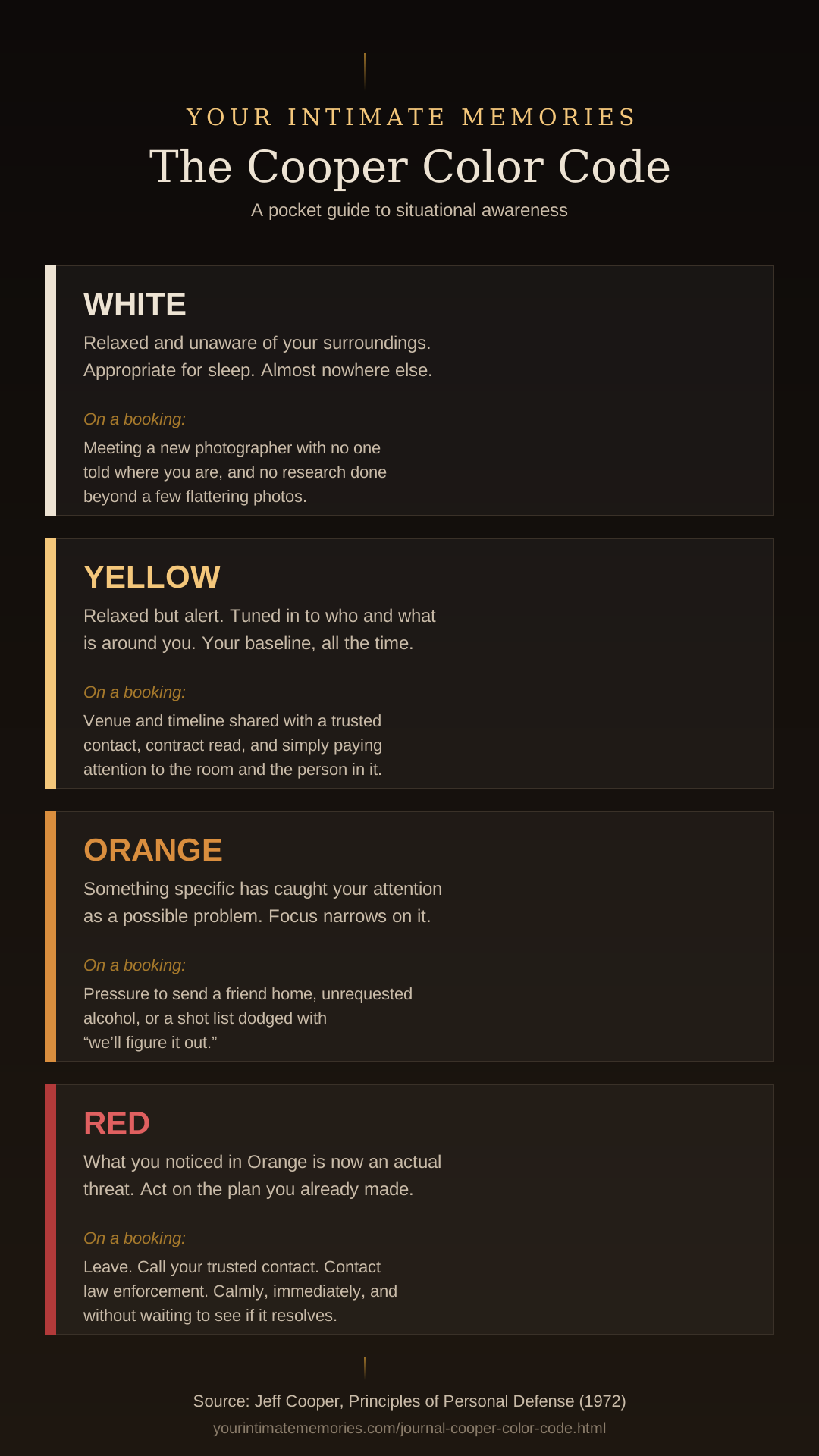
Sharing it forward
None of this is proprietary, and none of it should stay with one model. The value of the Color Code compounds the more people around you actually use it. Share the table above with another model before a joint booking. Send it to whoever you name as your trusted contact so they understand what Condition Yellow on your end actually looks like, and what a shift to Orange or Red from you should mean to them. Bring it up with newer models who haven't had a reason to think about any of this yet. A community that shares this kind of awareness openly, rather than treating it as something learned the hard way after a bad experience, is a community that catches problems earlier and more often.
Why safety ultimately depends on you
No contract, chaperone policy, or safety card replaces the person actually paying attention in the room. Vetting a photographer in advance, covered in my companion piece on how to vet a photographer, and knowing the warning signs covered in red flags to watch for, both matter, and both work best alongside a habit of staying in Condition Yellow rather than Condition White by default. The Color Code doesn't make the decision for you. It buys you the time to make it yourself, while you still have every option available. That time is the entire point, and it's yours to use.
Thank you all for reading.
Stay Creative, and Stay Safe.
Jeshua.